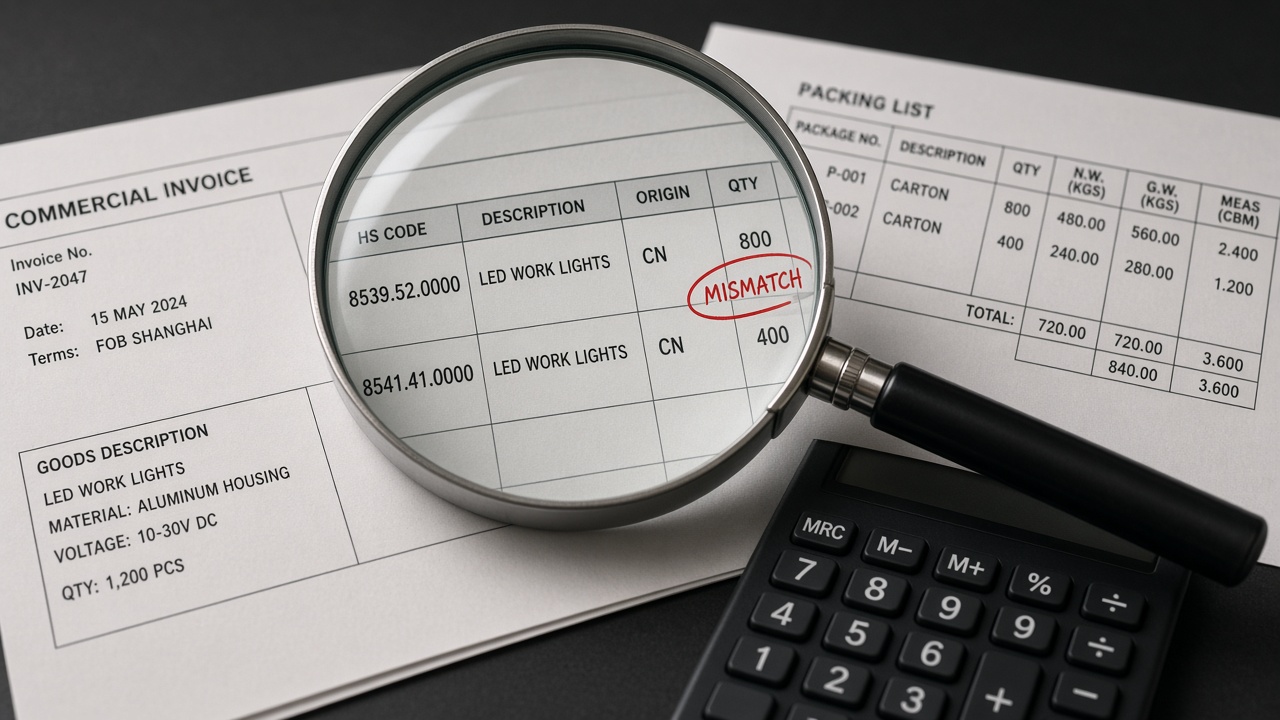
The cost of documentation errors
Documentation errors are the silent tax on Australian imports. RKM Logistics resolves holds weekly where invoice quantities, packing list weights, and bill of lading figures disagree by small margins — enough to trigger broker queries or examination referrals.
Storage at terminal or bonded facilities accrues while documents are amended across time zones. Payment under letter of credit fails when descriptions differ between documents. Each event is preventable with template discipline at origin.

We recommend triple-match checks before cargo gates in: commercial invoice, packing list, and transport bill must align on shipper, consignee, pieces, weights, and description granularity suitable for HS classification. Suppliers should email scanned sets before uplift for spot checks.
Electronic lodgement does not forgive bad data — it accelerates detection. Invest in master data for recurring SKUs rather than retyping descriptions per shipment.

Treating documentation as operational infrastructure — not admin afterthought — improves clearance predictability more than chasing the cheapest ocean rate.
Common failure patterns we see
Mixed units (kg vs lb) on packing lists, invoice dates that post-date transport bill issue, and consignee names that differ slightly from Australian Business Register records all delay release. Letter-of-credit shipments fail bank presentation for smaller textual mismatches than customs tolerates on repeat trade lanes.
Triple-match in practice
Shipper and consignee names must match across invoice, packing list, and transport bill — including punctuation and entity suffixes. Weights should be gross for each document set; net-only packing lists against gross bills trigger queries.
HS-ready descriptions belong at six-digit granularity where possible; “parts” and “accessories” waste broker time and invite examination. Email scanned sets to your coordinator before uplift for spot checks on new suppliers.
After a hold occurs
Capture root cause (template drift, supplier change, manual retyping) and fix the template — not only the single shipment. Recurring SKU master data pays back faster than repeated emergency document reissues across time zones.